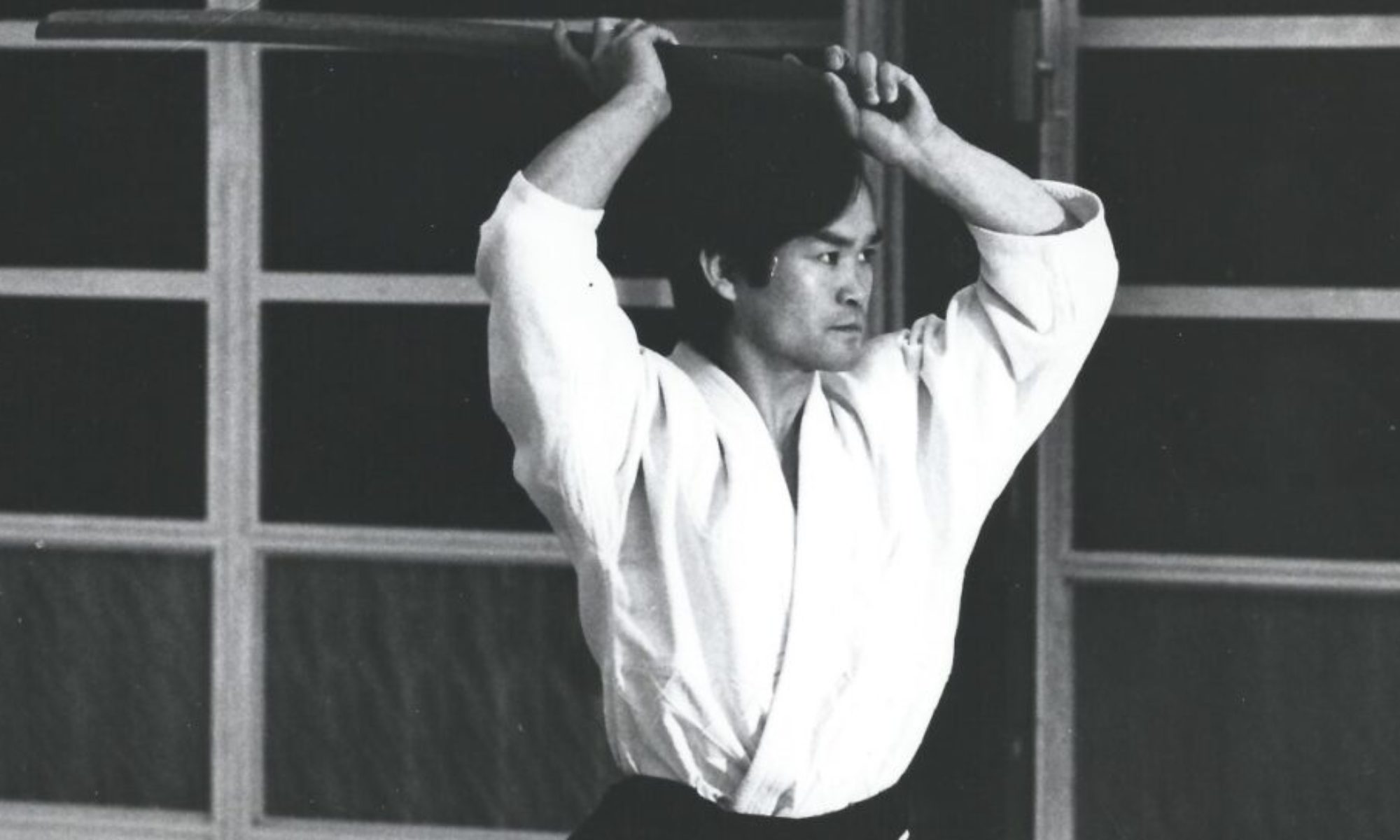
G. Lyons, Bucks County Aikikai
“As the nature of Man cannot be divided in two – into the spirit and the physical – through initially learning the forms physically, we also come to discover the types of energy and states of consciousness required to perfect the forms. And that is the most important thing of all.” T.K .Chiba
During a regular evening class at San Diego Aikikai back in the 80’s, Chiba Sensei was picking me up to take his ukemi. I didn’t realize it then but it was the beginning of a change for me. In the early days of my training I had read a lot of books on Aikido. Back then I loved to think and talk about it. I could talk and talk and if you walked away I could go on without you, no problem with my running inner dialogue.
On this night though, my intellectual insights, my lofty Aikido ideas, were of no help to me. Stuck in my head, mind too slow to keep up, fight or flight kicking in, the class looking on, I was getting my head handed to me. Added to the challenge of facing these apparent life and death moments, and as juxtaposition, I was paired with a beginner who I was taking care of as part of my kenshusei responsibilities.
Truthfully, I felt more like I needed a corner man, some patching up, maybe a few words of encouragement. Instead I’m working with this new guy who’s trying to ask if I’m okay while I’m trying to explain to him where he should put his foot. If we had a little more time together he probably would have asked how the hell these demonstrations were demonstrations of “the art of peace”, a subject I normally would have been happy to talk about.
For Aikidoists, classes follow a familiar form: the teacher demonstrates, the student replicates. There may be a hope that one day the student will be master of the art in their own right but at the beginning the task is to get into the skin of the teacher, feel what they feel, move like they move. If a student prematurely deviates from this model, it is likely the throes of a personality resistant or unwilling to change.
This way of learning is a non-verbal one and more of a cultural norm in Japan than it is here in the States. Beyond this, we could also say that in any culture different people learn in different ways. Both points are valid. So we are faced with a question: is it possible to shift our consciousness and learn different ways of learning? Can we learn to learn without words intermediating between ourselves and others or between ourselves and the art? Is it possible to not simply refrain from talking but to actually slip into a non-verbal state of consciousness?
Back to my rough evening in San Diego and my situation with Chiba Sensei on the one hand and new guy on the other. My ideas of what I was supposed to be doing were not helping. I wanted to do well in both spheres but wasn’t in either. Trying to anticipate Sensei’s technique only turned up his intensity and no matter how many times you tell a beginner to move their right foot they can be stymied that they have feet at all.
I think that initially, for a lot of us in this country, being told not to talk doesn’t make any sense. What would be the point of that? It might even remind us of being scolded by an exasperated parent or teacher. Childhood traumas aside, learning the art is difficult enough without unnecessary constraints. Words naturally arise as we try to get hold of ideas and ideas themselves bring more words as we try to articulate them. A back and forth between teacher and student is enjoyable and helps us form a solid idea of what we are doing and a reasonable opinion as to why we are doing it… and didn’t O’Sensei say practice should be enjoyable?
Not talking during training is old school and Chiba Sensei warned us against losing it. It’s no secret he was an intense teacher. To get on the mat with him was serious. You may have heard stories of people running off at the sight of him. If you stayed you knew the training would be rigorous. But so what? A lot of physical activities are rigorous. The difference was that in Chiba Sensei’s classes the atmosphere was thick. He brought an intensity to the room that elevated the level of practice. In Sensei’s class, not talking didn’t really need to be a directive; it just seemed like the best choice.
We learn by distinguishing differences and I had a big one that night in San Diego. There were few words needed between Sensei and me and of course a few words between me and the new guy were appropriate, more than a few probably wasted. For me though it was time to start working on not getting stuck in explanations and to start looking for or at least imagining a state of mind where being and doing are prioritized and arise without the need for intellectual interference or translation, a state of mind where words and ideas are not central, a state of mind where there is, well… you know, no talking.
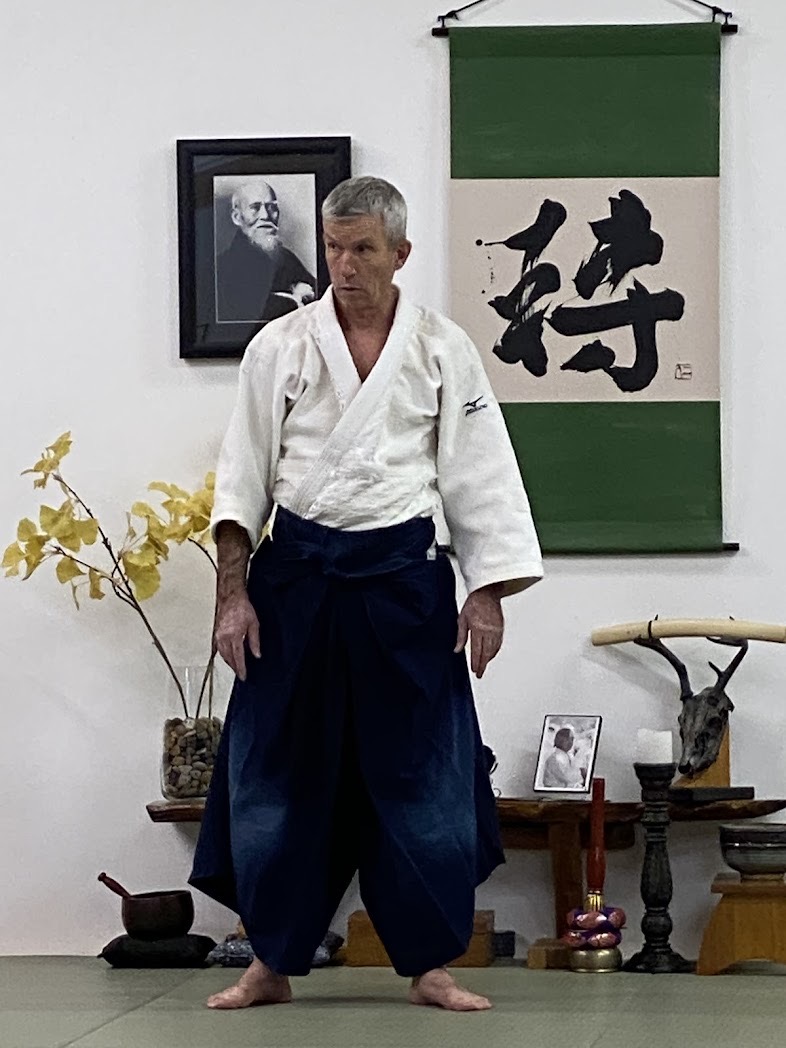
Thank you
This is a very fine passage that reveals the atmosphere during Chiba’s classes. He had a powerful presence that remains in our hearts – those who had contact with him in Aikido.
Watching his extention and consciousness was a solid platform for me.
Thank for the spirit of Aiki
Nice you had me laughing and have flashbacks at the same time.