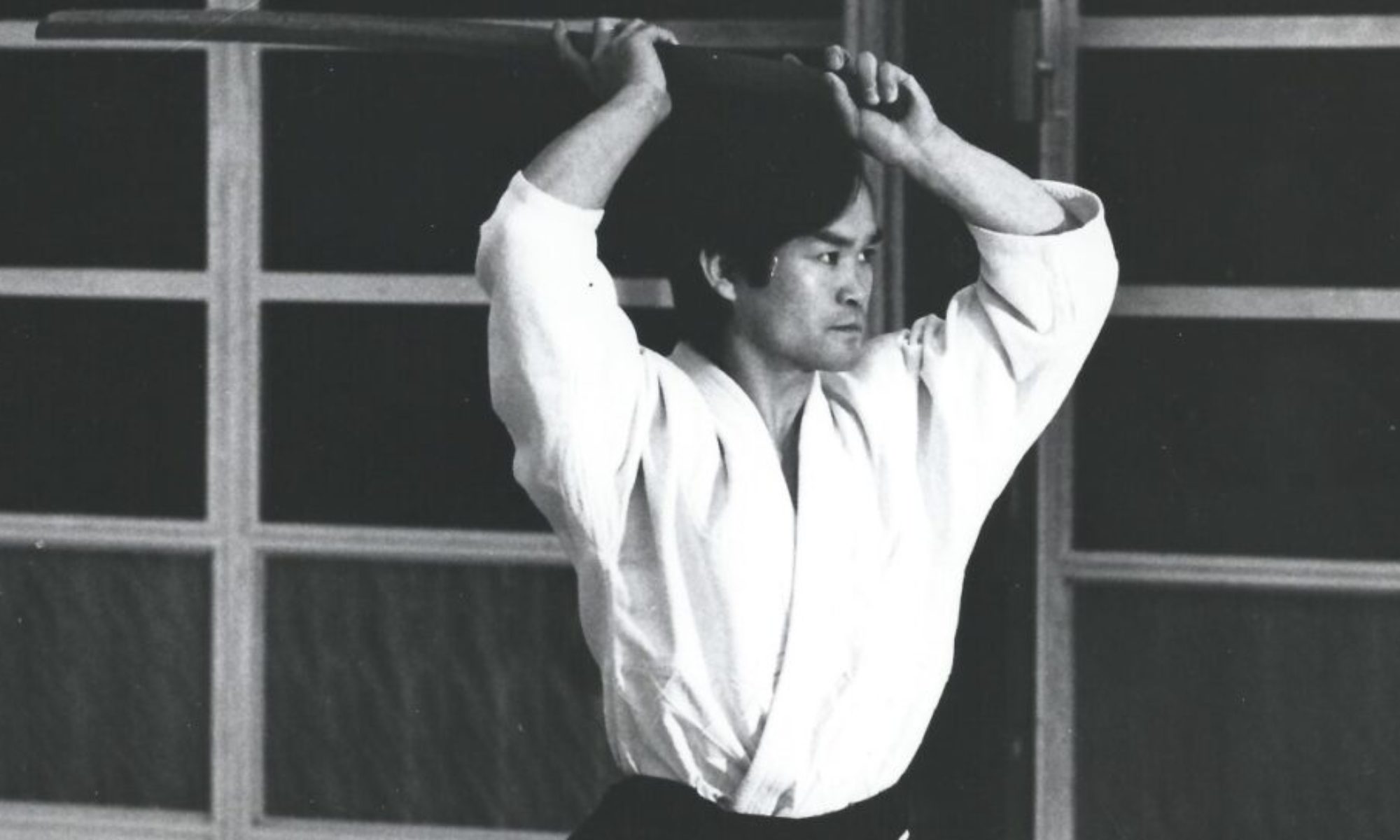
Diane Deskin, Sonoran Aikikai
I arrived at San Diego Aikikai in February of 1995 and left in July of 2001. I came there from Santa Fe, New Mexico, where I had started my Aikido training in 1991 with Rihab Yaqub, a student of Chiba Sensei’s. Prior to my arrival, I formally requested and received permission from Chiba Sensei to come to San Diego for six months to prepare for my shodan exam and to train as his personal student. At the end of my first three months, I was certain that I wanted to continue my training with Chiba Sensei, and six months became six years.
The two stories below are just a few of the many Sensei stories and memories that have roamed, free-range style, in my noggin over the years. They are wildly different stories, but both are from my time in the Fairmount Avenue dojo in 1995 and early 1996.
Chiba Sensei’s fierce and powerful technique, angry outbursts, pressure-cooker method of teaching his personal students, and even his generous nature, may be well known. But Sensei was also engaging, charming, expressive, and funny. His mannerisms, the way he moved, the way he spoke, his smile and laugh, his expressive eyebrows—all these little things take up more space in my memories of him than the heavier, scary and painful moments do. The first story is from a very painful time and the second is from one of the many lighter moments I shared with Sensei.
As I said earlier, I originally came to San Diego in 1995 as a first kyu preparing for my shodan exam. Fast-forward to summer camp 1995. I was thirty-three years old, officially a kenshusei at San Diego Aikikai, and was preparing to take my shodan test at camp. There were several other kenshusei who were also scheduled to take various exams at camp and as kenshusei, we had many responsibilities beyond training at camp. The night before examinations, Chiba Sensei had received word that several of his kenshusei had not met their financial obligations to Hombu Dojo in a timely manner. He was absolutely furious and disappointed with the whole group, and we received a major tongue-lashing. The remainder of camp was a slow-motion blur of misery. The kenshusei at that time included several international students who lived in the dojo as uchideshi. None of us knew what was going to happen next. A few days after we returned to San Diego, there was a small written notice on the bulletin board (on the everyday stationery that many of you may remember—a simple white piece of paper with “From the desk of T.K. Chiba” printed at the top) announcing that the kenshusei program had been disloved until further notice and those living in the dojo had a specific amount of time to get their affairs in order. Now, we all knew that he meant to say that the kenshusei program had been dissolved, but disloved was a brutally accurate description of the way we felt. It was definitely the way I felt. As always, Sensei cut directly through the center, even with his unintentional misspelling.
My memories of the next few weeks are painted more with the broad brush of emotion versus actual events, but there were large quantities of beer and lots of hanging out together while saying very little. I do remember one specific night at Dave Alonzo and Mike Sidebottom’s shared apartment, where I watched Dave crawl into his stereo cabinet under the auspices of fixing something in order to momentarily disappear from the shared and individual misery we were feeling. On that night, Dave did what I think we all really wanted to do—crawl into a dark space and disappear for a bit. Several international students had planned to return home at the end of the summer. They left a little early or stayed with students outside of the dojo; others disappeared for a while—some took a break from training, some were already planning to move on due to jobs and other upcoming life changes—and a few of us continued to train quietly as general members. I had just moved the remainder of my belongings from Santa Fe and had accepted a regular job in San Diego; I had no plans to go anywhere. Mike Sidebottom and I decided to stick it out after talking many times with Mrs. Chiba and Murashige Sensei, who both told us that we should hang in there and train sincerely, and that eventually Sensei would make his intentions clear. A few months later, another small notice appeared on the bulletin board that the kenshusei program would be restarting, and that prior to acceptance, anyone interested (new or old) would be required to apply with an essay and an interview with Chiba Sensei. I won’t go into the details of my interview, but I did get the chance to practice my “ducking a rapidly moving ashtray as a projectile” skills. In the end, I was accepted into the new program. I think Sensei had different individual discussions and perhaps written communications with most of us, and although he had one general message for the group with the dissolution of the program, he had individual observations for each of us. For me, the subject of his personal feedback was generally accurate, difficult to accept, and in part involved issues that I still work on today. He knew us well.
For the first month or so, it was only me and Mike Sidebottom in the new program. Sensei told us that for an unspecified period of time, kenshusei classes would consist of a focused study group of the kyu tapes (with particular attention to the 3rd kyu and 1st kyu tapes) and that there would be a test at the end before regular kenshusei classes resumed. We had no idea if he meant a written test or a physical test, but there was no way we were going to ask him to clarify. Mike and I spent many hours in the same little blue room where I had earlier gotten to practice my ashtray-ducking skills. We studied those VHS kyu tapes like kyu-tape-studying maniacs. We took notes, we drew stick figure aikido illustrations, we discussed, we practiced openings (it was a tiny room), we discussed more, we watched more, and on and on we went. (I still have those notebooks today.) After a few months of this, a few other folks had been accepted into the program, and another little notice went up announcing the start of kenshusei classes. Mike and I were never asked to take a test on the kyu tapes, and back to kenshusei life we went.
As an aside, everyone who had been in the kenshusei program at the time of its dissolution eventually made their way back to Sensei, one way or another.
For me, this difficult period of time was the embryonic phase of a lifelong process of navigating my relationship with Sensei. Even ten years after his death, I’m still navigating, processing, learning, appreciating, and occasionally ducking. —Never underestimate the importance of knowing when to duck.
One night several months after the reformation of the kenshusei program, we were at a local bar with Sensei. We were still in the Fairmount Dojo, but we already knew it was going to be torn down and that we would be moving to Adams Avenue. There was a fairly large group of us having beers with Sensei, and I was perched on a barstool facing him. I looked down from my barstool to see Chiba Sensei wearing a pair of my shoes. Now, these weren’t girly shoes by any means, but they were clearly women’s slip-on canvas shoes. At some point I must have left them in the shoe rack near the dojo’s back kitchen door. He was wearing them with the backs all smashed down (like he often did to his everyday shoes). I must have been staring at his feet, because I looked up and saw him looking at me, looking at him wearing my shoes. He appeared flustered for a moment, and then gave me a sly half-smile with those expressive raised eyebrows, shook his head, and said, “Anyway, they don’t fit me!” I have no idea what happened to those shoes. I never saw them again on his feet or on my feet.
While his powerful technique, intense nature, heavy hand, and even his temper are well marked in my memory, it’s the lighter moments—his smile and laugh, his idiosyncrasies, and the time I shared with him, Murashige Sensei, Mrs. Chiba, and other students over the years that continue to lighten my heart and stay with me in a deep way. Some days it feels like a lifetime ago and others it feels like yesterday. Sensei, you left your mark in so many ways. I am grateful for the good and bad times. I am grateful that I was your student and that I got to be deeply immersed in your world for such an extended time. You are still missed.
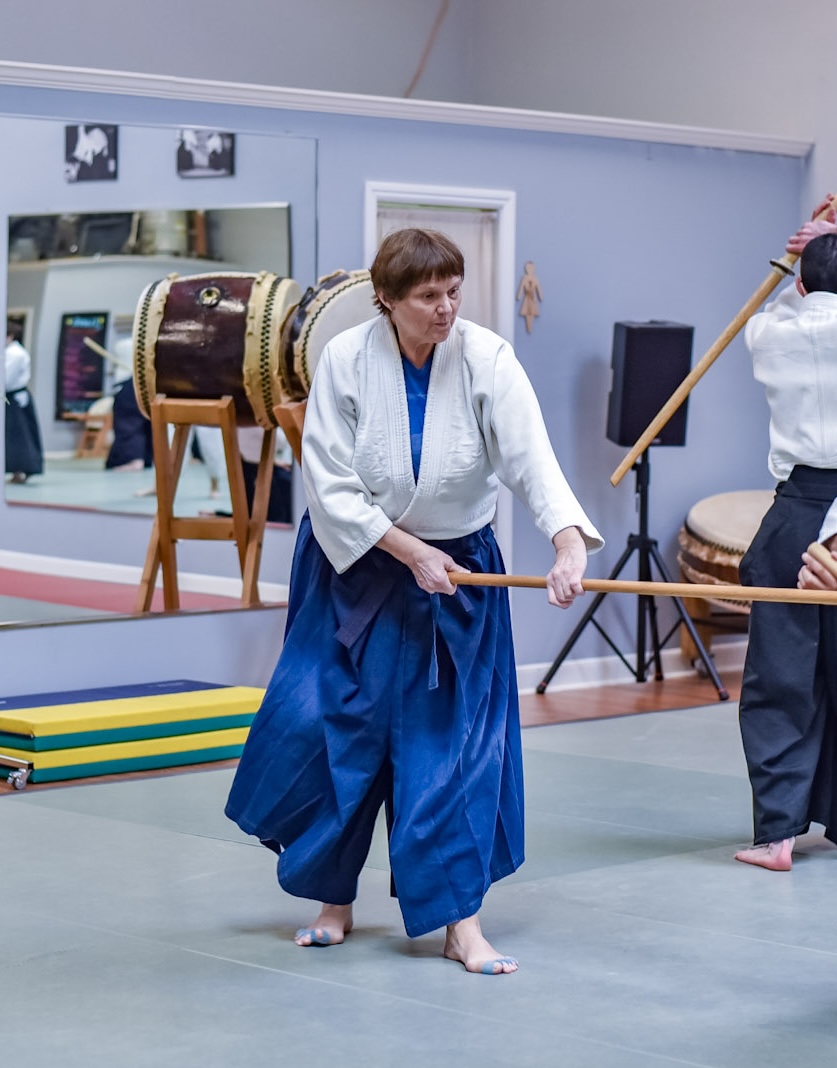
Deskins Sensei teaching March 2026
Editor’s note: this article originally appeared in Remembering Chiba Sensei, the chapbook given out at Summer Camp 2025.