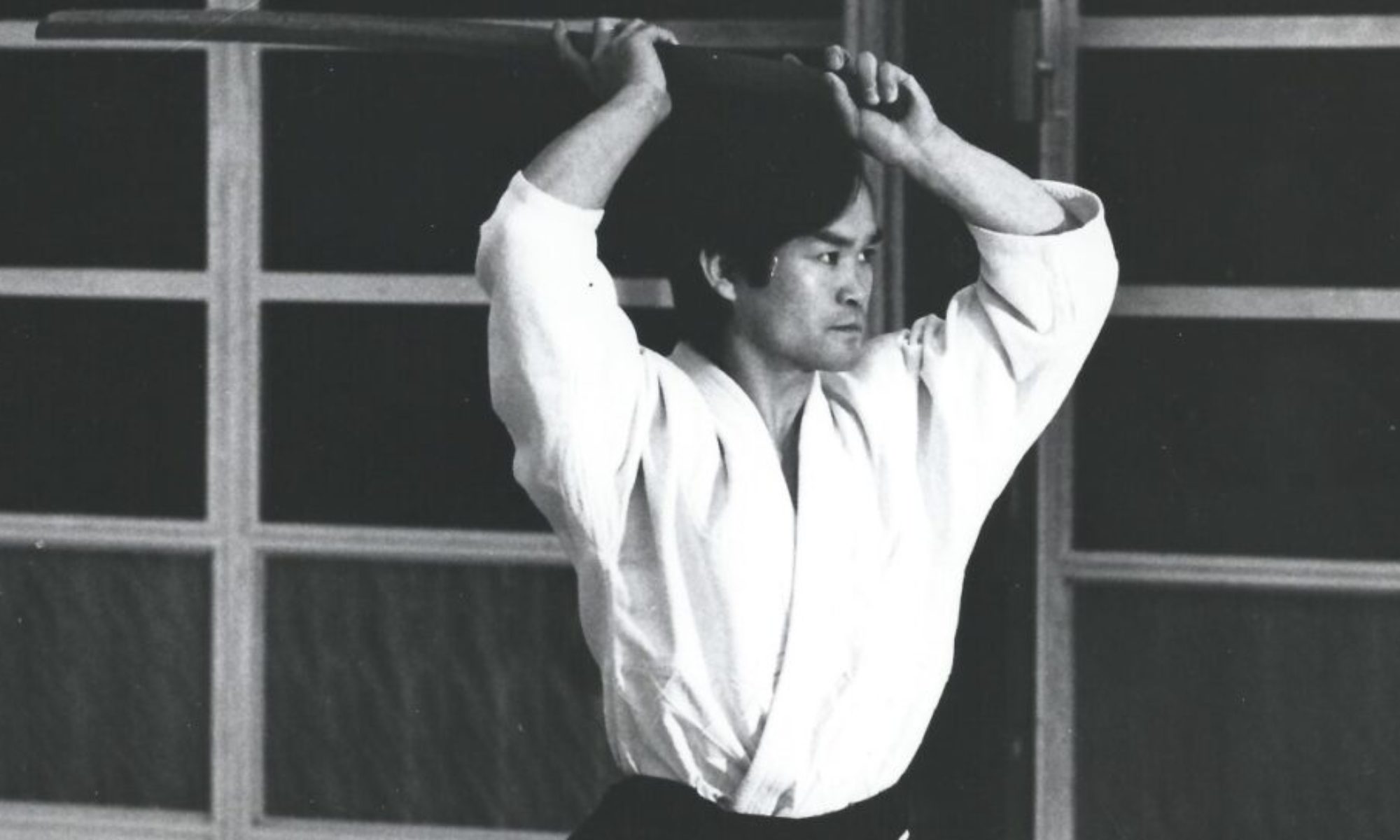
Cecilia Ramos, Grass Valley Aikikai
Last Spring, to my surprise, I was recruited to be a fight choreographer for a theatrical play in our small town. I did it, it was delightful, and now that the experience is behind me I would like to share the story of it with all of you who read this newsletter. I should think that any of our Birankai instructors would be able to do this too if the opportunity came their way. But having done it, there are some things I would do differently if I were to do it again, so if the experience comes your way I hope you can benefit from my tale.
The play was Rashomon, which was one of the first samurai movies by Akira Kurosawa. I had seen the movie once upon a time but didn’t remember it very well. Fortunately it is available on YouTube so I was able to refresh my memory. It came out in 1950 and won many awards. It is still considered one of the greatest movies ever made. It starred Toshiro Mifune, in one of his first roles. Later, in the 1960s, it was made into a Broadway play. With our Birankai emphasis on weapons training I felt sure I could do it so I agreed to take it on.
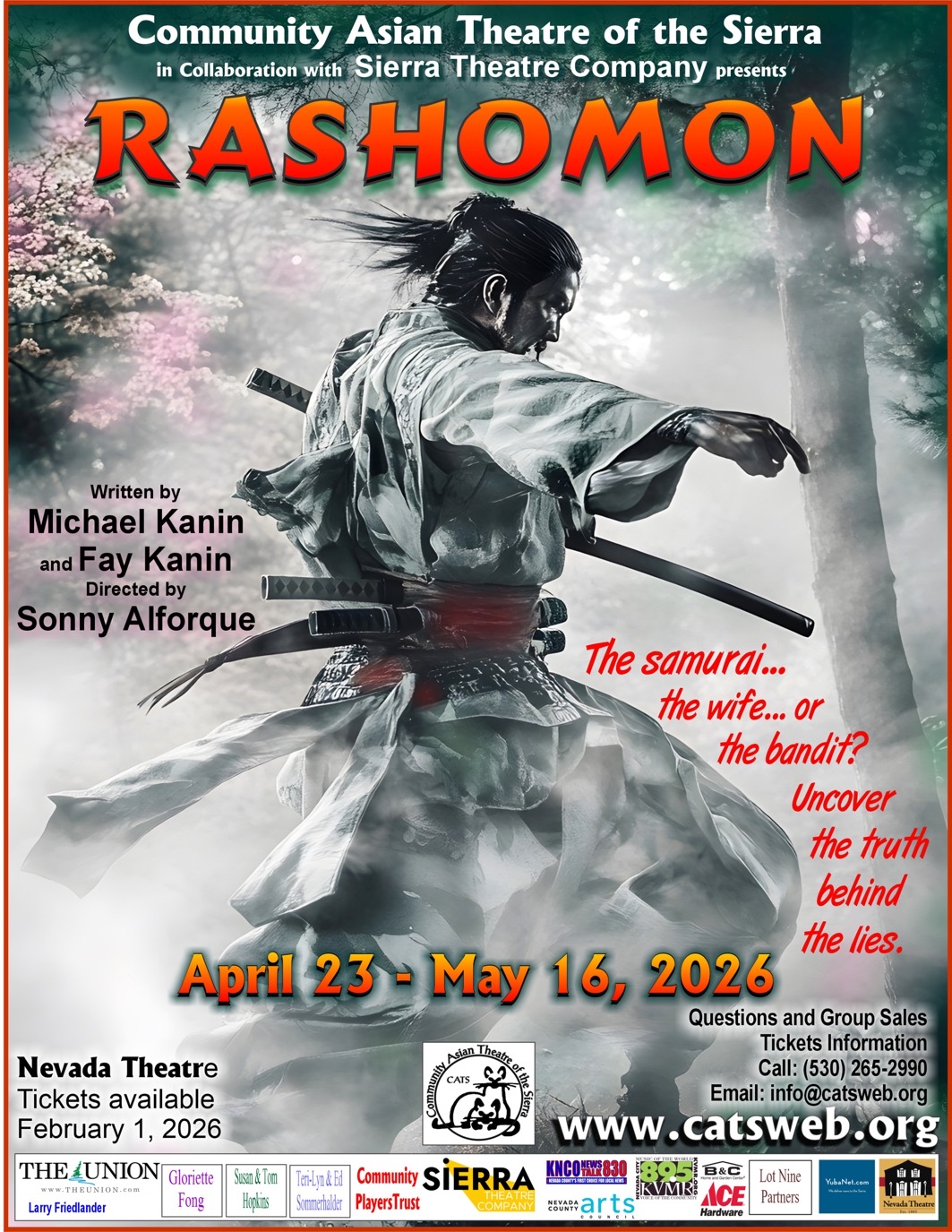
The plot revolves around an incident in which a samurai and his wife, while traveling through a forest, are waylaid by a bandit. The bandit rapes the wife and kills the husband. Four witnesses tell four different stories of what occurred. The point is that different people perceive reality differently.
But despite the film’s renown, watching the fight scenes from the vantage point of being an instructor of swordsmanship, I must say that I wasn’t impressed. It seemed like a lot of wild slashing and falling down. The director came to the dojo and my students and I demonstrated some of our bokken forms for him. He readily agreed that the sword fighting should not try to be true to the movie and that he would want to see more contact sword to sword.
Swords
The first little curve ball was that the director and the prop master had decided that the actors should use real swords. I explained our conventional thinking that for partner work we use wooden swords because with real swords either you kill each other or you break the swords. I suggested we use wooden swords painted silver and that the paint could be touched up between performances. But the prop master felt that the swords he found were not expensive, that he would have back up swords, and that he would repair any damage after each use. My student and I were fearful to try it so we started with kirigaeshi, slow and gentle, and built up to full speed and full strength. It worked, we didn’t kill each other. Afterward the swords definitely had little dents all along the edges but were not broken.
There were five swords, all in the $100 range and all from different manufacturers. I have always been told that $100 swords were meant to be decorative and that they would not hold up to use, and that in particular the handles would not hold up. However, I must say that all five of the swords seemed to have well made handles and were nicely weighted. Based on this experience I don’t see a problem with beginning Iaido students starting with a $100 sword until they are ready to splurge on a sword of better quality
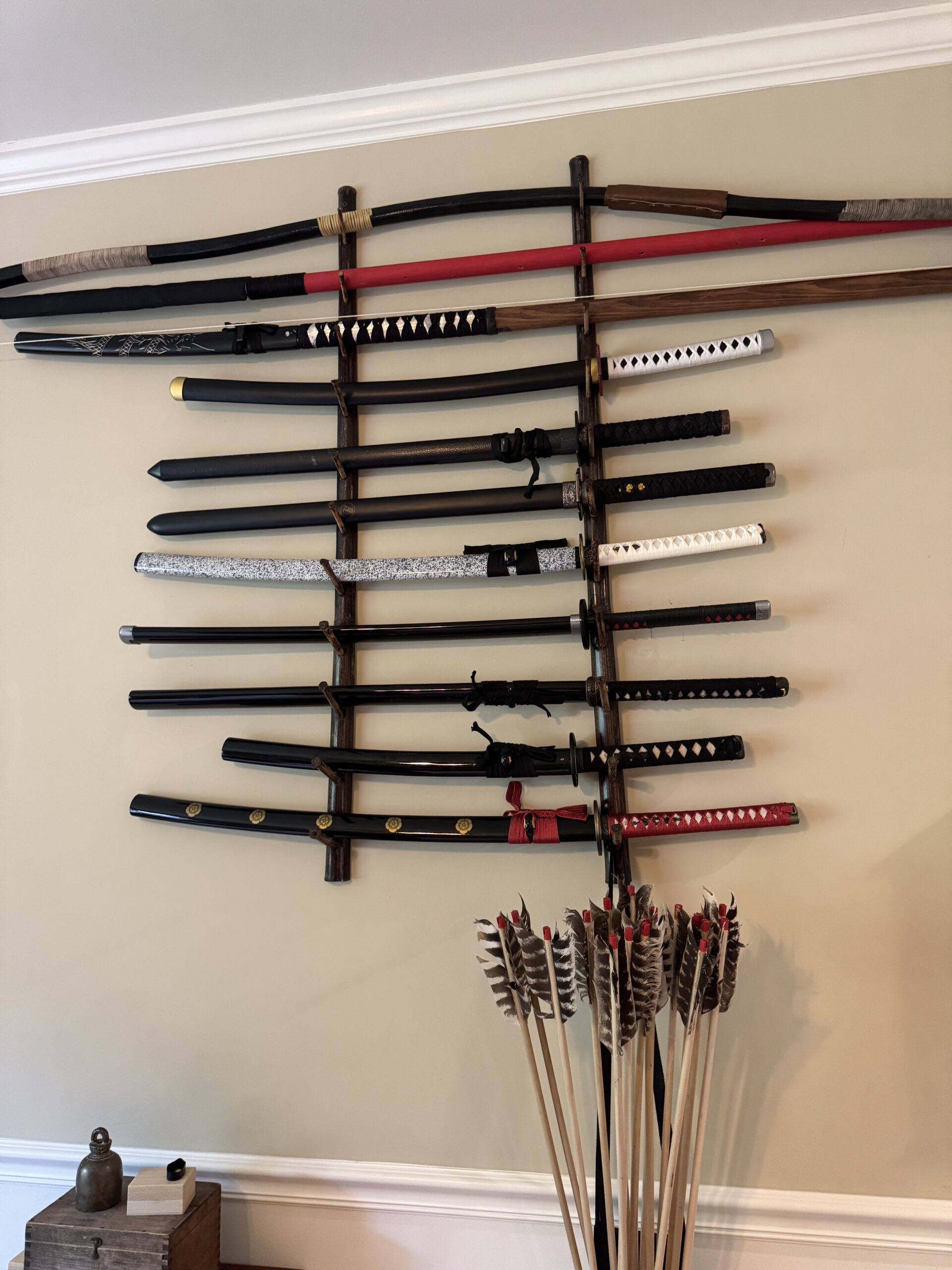
The prop master’s collection of weapons
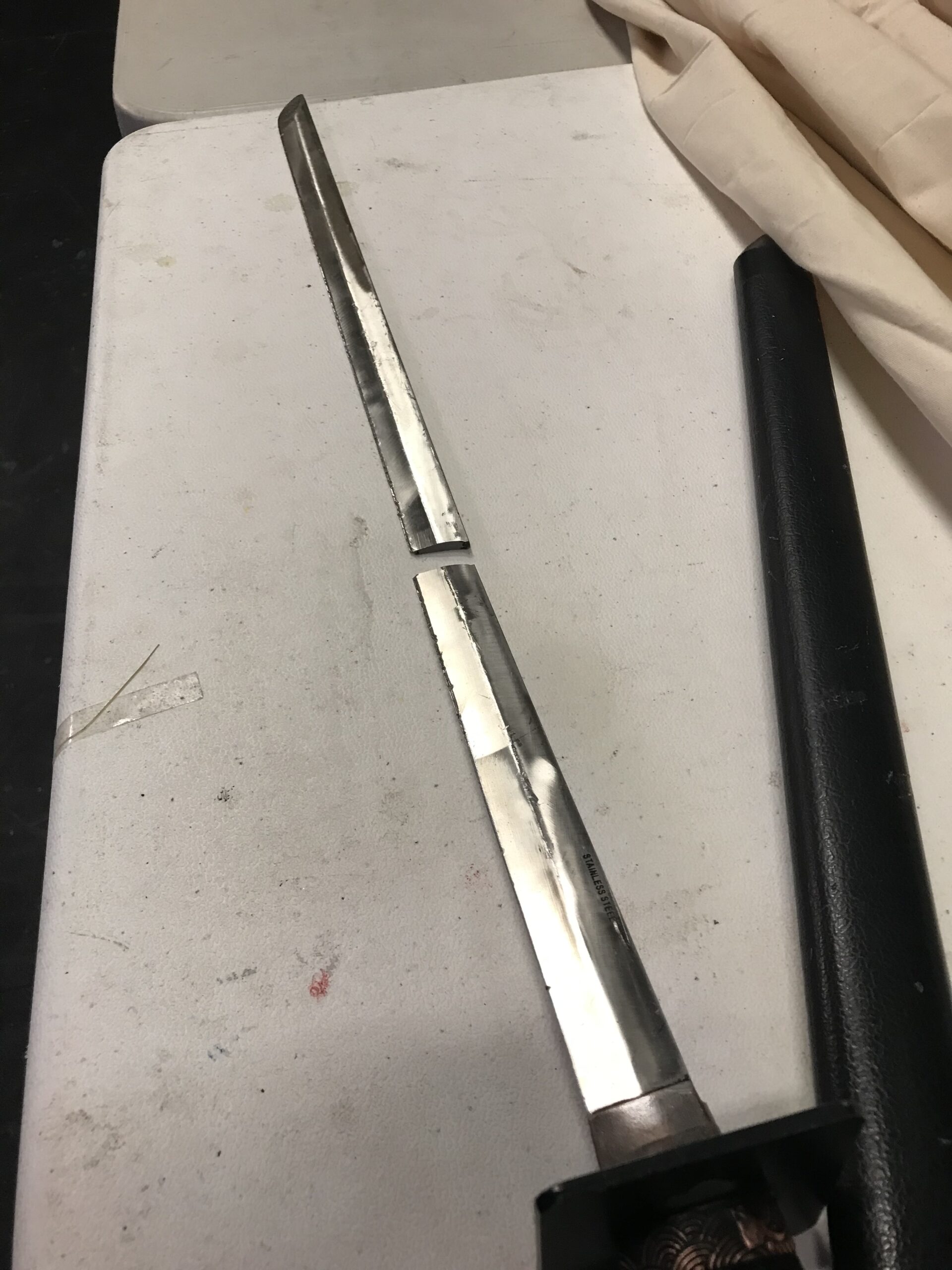
At the start of rehearsals I gave the actors a few lessons on suburi, kirigaeshi, and uchikome using bokken. After that it was straight to metal swords. Although the swords were not live blades, several had bluntly cut edges that therefore in effect had two sharp edges. I have no doubt that this type of edge could cause injury. The actors were two delightful young men, with great enthusiasm and attitudes, but little caution. In the course of rehearsals and performances one actor managed to stab himself once in the stomach and his partner once in the leg, although neither strike broke the skin. After each rehearsal and performance the prop master had to file the edges. Eventually one sword bent at the hilt so badly it could not be repaired. Another sword snapped in two in the middle during a performance. The broken half fell to the stage and the audience believed it had been planned. But, oh, it could so easily have flown into the audience and hurt someone. The actors were threatened to go slower and be more careful, but I doubt it had any effect.
I wasn’t the only fight coordinator. A fencing guy was also recruited and he had a lot of theatrical experience. He taught me a lot about choreographing for the stage as opposed to movies or real fighting. I learned that for the theater it’s all about what the audience sees. An actor should avoid turning their back to the audience at all, movements should be designed so that the actors’ faces are not blocked, and if they are using two hands, then the higher hand should be the upstage hand. Something that was hard for me was that the actors are trained to not strike at the target but to strike downstage of the target (and surprisingly the audience can’t tell).
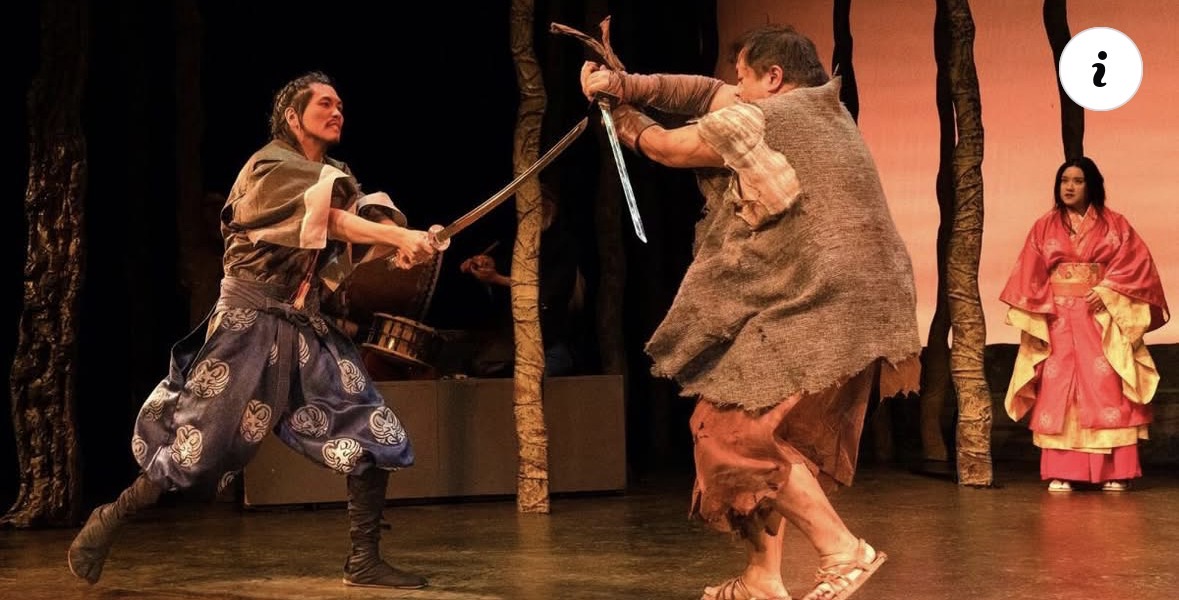
Here you can see that the samurai had aimed to the side of the bandit
Fight Scenes
There were two main fight scenes. Both were between the samurai and the bandit. In the first fight, according to the bandit’s testimony, both fighters are skilled fighters, but the bandit prevails and kills the samurai. In the second fight, witnessed by a passerby, a woodcutter, both fighters are inept cowards, and the samurai dies by accidentally falling on his own sword.
Therefore my assignment was to create one fight scene in which the samurai would be traditionally skilled and the bandit would have the skill of a wild man. In the other fight scene they were both to be clumsy and unskilled. It was a challenge for me to design something that showed “bad” fighting technique. We mostly accomplished it by emphasizing acting – they actors had to tremble and show with their body language that they were afraid.
A Collaboration
Once rehearsals started I discovered that the creative process was a collaboration between the director, the actors, and the choreographers. I cannot claim credit for the fight scenes. It was a true collaboration. There were many places I could point to and say that was my contribution, but there were also many other places where I was overridden. In the second scene, where the fighters are supposed to be bad, it was easy to go along with the decisions of others. But for the first fight, I could accept the bandit’s moves because he was a wild man, but I had to speak up and insist that the samurai move properly. Even so, I am not proud for my fellow Birankai instructors to see the first fight. The actors look like little boys playing at fighting. The audience loved it but you all would probably find it amateurish, which it was.
https://biran.birankai.org/wp-content/uploads/2026/09/IMG_2588.mov
This is what I would do differently if I had to do it all again. I would refuse to use real swords even if technically blunt. It was too dangerous. I would specify from the start that more time be allotted for me to work with the actors. I know that if I had had another few hours that I could have made them significantly better. I could see that we were all under the pressure of the deadline of opening night. As the deadline approached there was just no time to add extra rehearsals.
Costumes and Hakama
Naturally the samurai was to be wearing a hakama. I showed the actor how to tie his hakama but I didn’t figure on his having a photo shoot ahead of schedule. No one told me so I wasn’t there and I only found out when the promo photos appeared on Facebook. The hakama was all wrong, the obi was on top of the hakama, and worse, he had his katana on his left hip and a wakizashi on the right hip. That was too much for me to accept and I had to have a little fit about it, firing off a bunch of emails. “It’s wrong, it’s stupid!” They tried to say that I was overreacting, that “no one will notice”. I answered, “Everyone Japanese in the audience, everyone who loves samurai movies, they will all notice!” I could accept the obi on top of the hakama, but the swords in the wrong position was too much! The promo photo was pulled.
So another thing I would do differently would be to ask to be a consultant on costuming. I didn’t see the costumes until the dress rehearsal and by then it was too late to make changes. A minor character, the court deputy, was also in a hakama and it wasn’t tied correctly. The actor tied all the ties in the back. I tried to correct it only to discover that it was a cheap, horrible hakama and the ties were so short they couldn’t be tied correctly. My suggestion that we sew on extensions was denied. I went to the Japanese person who was the linguistics consultant but he said “Oh, Cecilia, it’s ok, no one in the audience will notice.” (This became the refrain that characterized the whole experience, “Oh, Cecilia, it’s ok, no one in the audience will notice.”) I got pretty tired of hearing it, although it was true. Generally I would answer, as above, “Everyone Japanese in the audience, everyone who loves samurai movies, they will all notice!” But to my knowledge no one ever complained about these things. The audience loved the play. We got wonderful reviews. And of course we are just a little theater in a little town. But it could have been better!
The Japanese consultant also said something that surprised me. He said that not even Japanese people in Japan know how to tie a hakama any more. If they have to wear one, say for a wedding or formal occasion, they rent one and the rental staff show them how to tie it. Tying a hakama has become a lost art. Only martial artists and actors know how, he said. (But our actor was an actor!) I later repeated this to a Japanese friend who disagreed, so who knows what is the truth of this. But the next time you tie on your hakama appreciate that you are practicing what may be a lost art!
Other things that were wrong were that the wife’s kimono had very long sleeves (which are worn by girls), and the samurai wore his hair in French braids. Have you ever seen a painting of a samurai in French braids? (“Oh, Cecilia, it’s ok, no one in the audience will notice.”) But I will say that the long sleeves looked well on stage and the actor was very handsome with his braids.
Katas
Our director invented a prologue that wasn’t in either the movie or the Broadway play and asked me to create a weapons kata of 20 seconds in length for each of five actors. The katas were to be performed simultaneously to the beat of Ravel’s Bolero (about 72 beats per minute – kind of fast in my opinion). He wanted a slow motion assumption of the ready positions, then fast motion ending with a shout, to create a “shock and awe” effect. I did it, combining bits and pieces from all our weapons curriculum. In the end, the actors didn’t really perform the katas as well as I would have wished. But my students and I had a good experience inventing the katas and performing them in two demos.
https://biran.birankai.org/wp-content/uploads/2026/09/IMG_2391.mov
Marci Martinez shows the Naginata kata
The samurai and the bandit’s katas were easier because they used swords. The wife had a tanto and her kata was essentially a partnerless version of JD Sandoval’s knife routine. (The whole time I felt JD smiling down on me from heaven.) The courtroom deputy was a problem because the director wanted the deputy to carry a jitte (a dagger-like weapon with a side arm). However, I discovered the jitte didn’t come into use until the 17th century and our play was set in the 12th century when a court deputy would carry either a yari (spear) or a sword. Somehow all of these weapons were rejected and the director settled on a short stick. But I could live with the short stick and used movements from my Tae Kwon Do days.
The craziest kata was that of the priest. He was a wandering priest and the director wanted him to have a naginata. In the 12th century priests were known to have naginata, used to defend temples. But it didn’t seem reasonable to me that a poor wandering priest would carry such a weapon. Nevertheless the director insisted so I created a kata using many of the movements in Sansho 2. It turned out to be a lovely kata (in my humble opinion). But the actor playing the priest was not an athletic person and he struggled to master the moves. He was the nicest person and was determined to learn the kata. I offered to simplify it, or even to have him just stand holding the naginata while the others performed, but he persisted. Nine private lessons later he could do it!
But in the end the joke was on me. With all five performing at once it was impossible for the observer to appreciate the subtleties of the separate katas. They could just as well waved the weapons around with random movements. But it made the effect of shock and awe that our director wanted, he was happy, and oh, well, Cecilia, the audience loved it!
https://biran.birankai.org/wp-content/uploads/2026/09/IMG_2568-1.mov
Advertising and Money
Was it worth it? Yes, in the sense that it was a wonderful experience. No, in that it was a much larger time commitment than I had expected and didn’t bring in new students. Once rehearsals got going I was drawn in and I wanted to give as much time as it needed to get a good result. For three months I devoted all my free time to the play and by the end I was tired and ready for it to be over. (Then once it was over I missed the camaraderie of my new friends and suffered from withdrawal.) I received an honorarium of $600 which really helped the dojo’s budget. We were in a parade and two demos. I figure about 2,000 people saw the performances and our dojo got a free half page ad in the program. We were allowed to put advertising cards in the lobby and all were taken. But now, six months later, no one has joined who saw us in the demos or the play. Many of the theater people made comments about wanting to join the dojo but so far none have.
I think the consensus among the BNA instructors is that demos might be fun but they do not bring in students. After 27 years of running a dojo I would say that nothing works to bring in new students. I think it’s the case that people develop an inner desire to do a martial art, and then they find you. So you have to be “findable”, and then provide quality training so they stay.
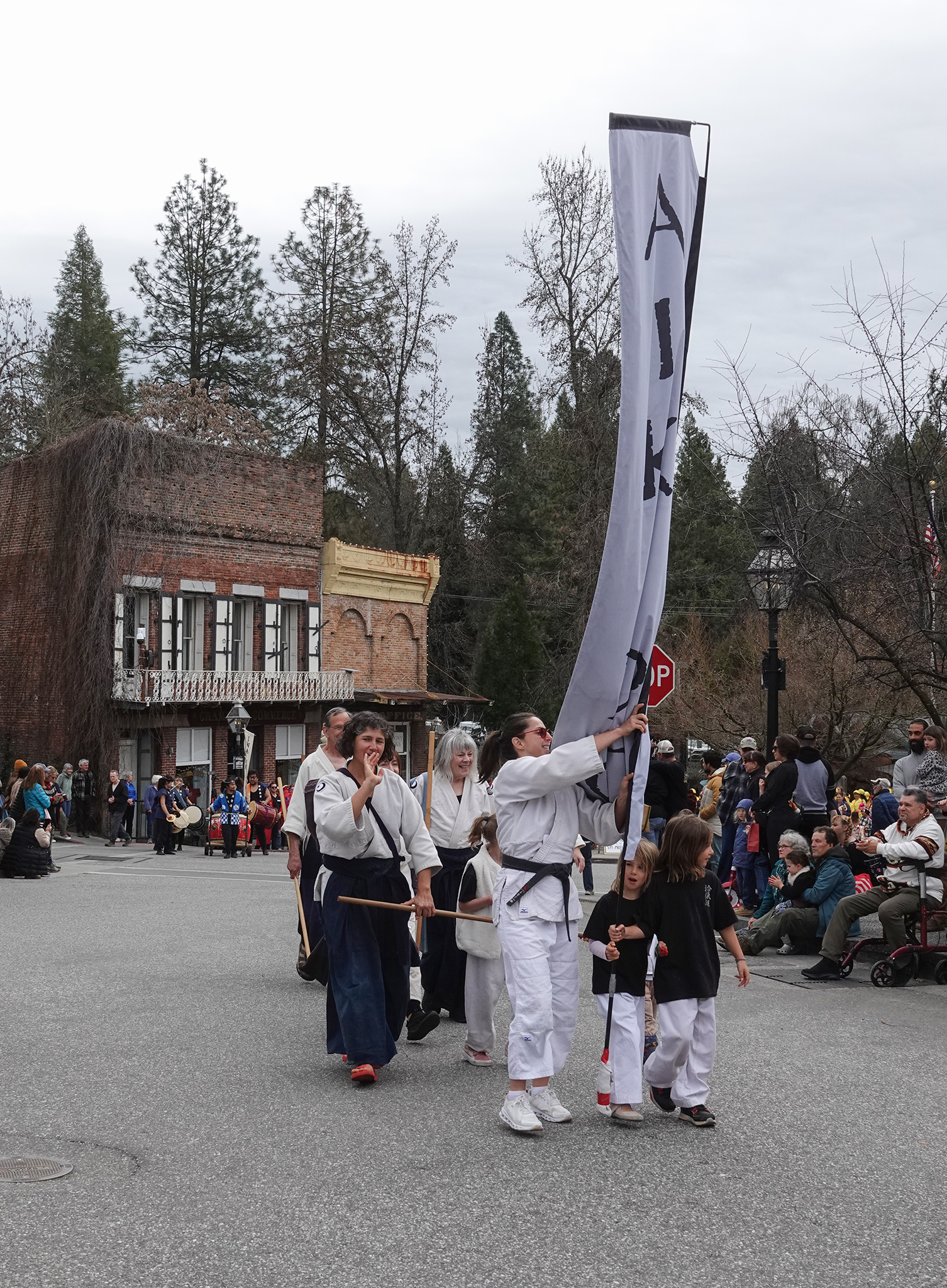
Our dojo in the Chinese New Year Parade in Nevada City.
The Nevada Theater
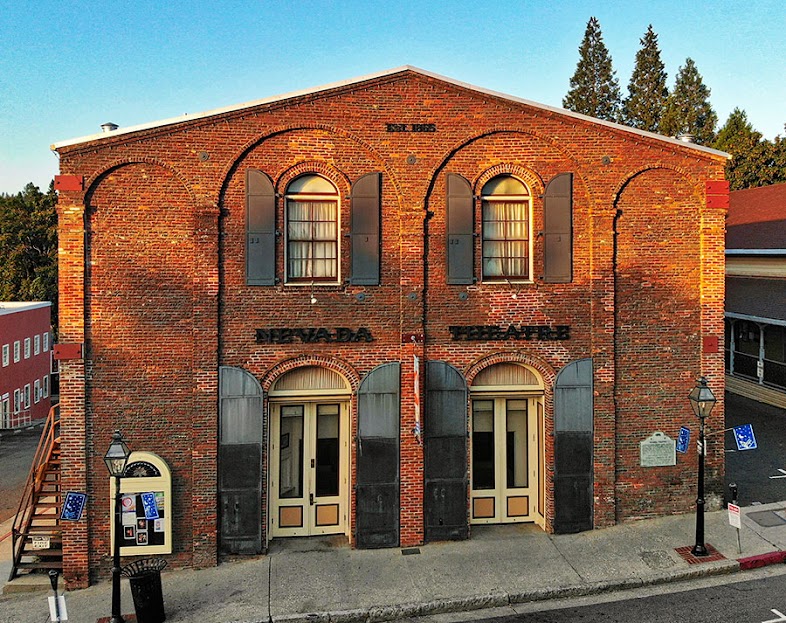
The Nevada Theater where the play ran is located in downtown Nevada City, California. It is the oldest still operating theater building west of the Mississippi River. It opened on September 11, 1865 and over the next several decades celebrities such as Mark Twain, Jack London, and Edwin Booth, whose younger brother was the infamous John Wilkes Booth, also appeared on the stage.
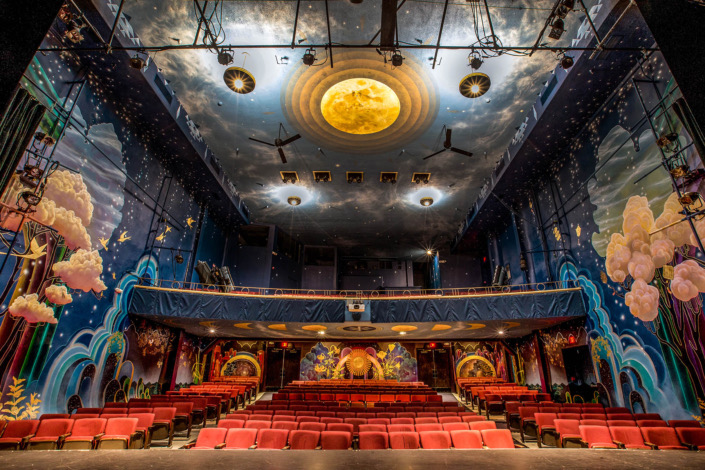
The interior was renovated during the pandemic and is magical.
Looking back, my favorite part of the whole experience came on opening night. There was to be a Gala Reception afterward and everyone had been asked to dress up. It was at intermission, in the ladies restroom. It was a fancy restroom, decorated in a Victorian style, and naturally there was a long line of ladies waiting their turn. Everyone was friendly, conversing about the wonders of the play, the stage design, the actors, the costumes, the fighting. It came out that I was the fight choreographer. An older woman, immaculately dressed and jeweled, turned to me and said, “How is it possible that someone like you, could be a fight choreographer?” I don’t think she meant it to be rude, but it sounded rude and the whole room fell silent in shock. But I laughed and diffused the tension, launching into an explanation of Aikido and our work with weapons, and the moment passed. But much later the comment comes back to my mind and I think how indeed did it come to pass that a shy little girl grew up to become the person I now am? How indeed! How did any of you find your path to the person you are today. Stories for another day…