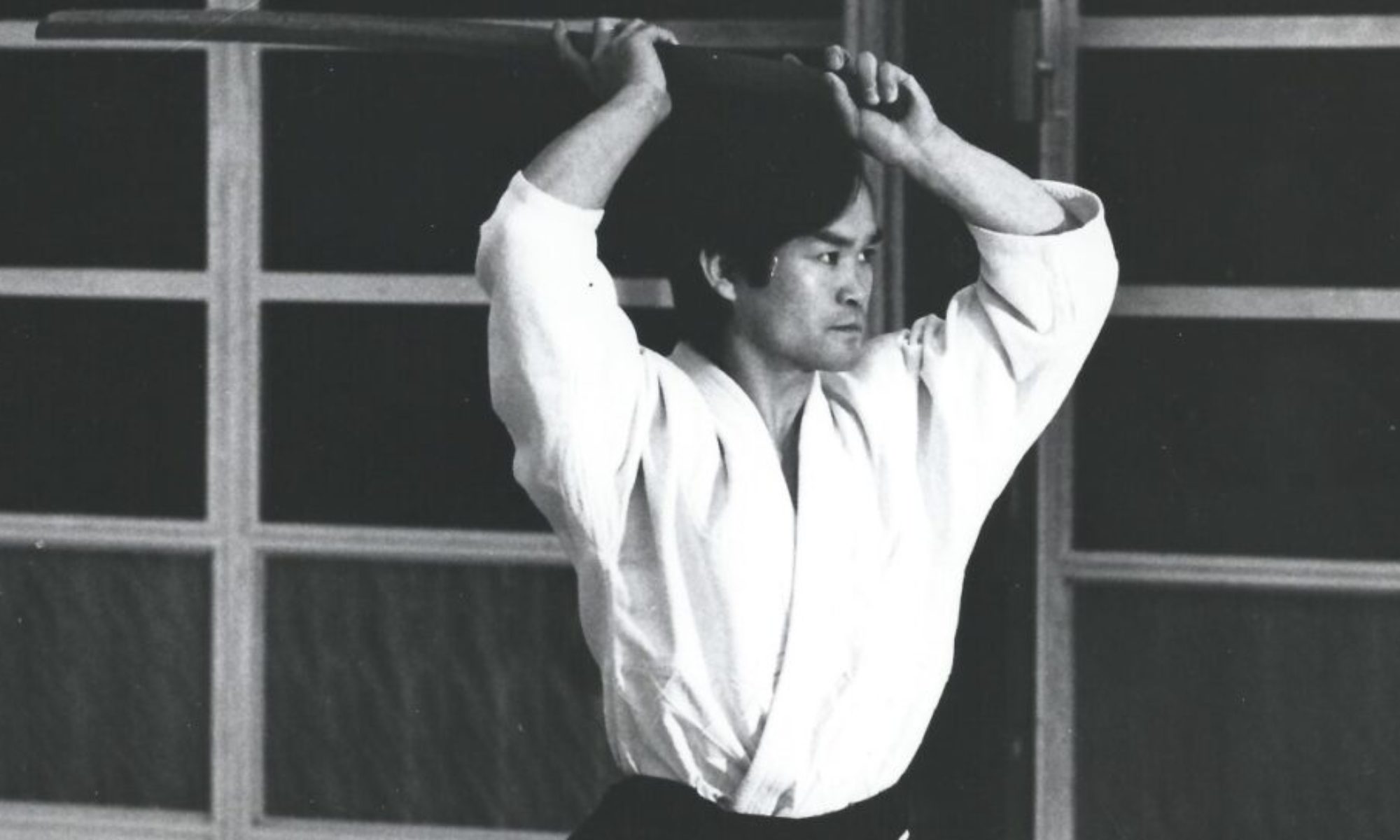
Dennis Belt, Ventura Aikikai
Years ago, sometime in the early 1990’s, I was assisting Iseri Sensei in editing some Summer Camp videos. There was quite a bit of video, as every class had been filmed in its entirety. We found ourselves increasingly watching scenes of Chiba Sensei walking around in his classes after demonstrating techniques. We eventually edited a short video of just that footage; it was mesmerizing. You saw Sensei completely in his element, easily walking through the (very) crowded dojo space, totally focused on what was going on. His eyes darted everywhere, seeing everything, missing nothing. At the time, I just took it as typical Chiba Sensei, doing his thing.
It’s only with the perspectives of time and distance that I realize what a remarkable example it was. While Sensei was actively teaching, his mastery of the art was obvious to everyone. What was less obvious to me, off in my own world of problem and concerns, was what it took for him to achieve such effortless command. Everything from moving his family halfway around the world to studying a foreign culture so as to better understand and instruct his students… I did not have eyes to see this.
I imagine everyone who has run a dojo has, in spite of their love of Aikido and the enthusiasm of their students, at times felt that their practice has become stale and flat. There used to be an easy cure for the problem: a visit to San Diego Aikikai or a seminar with Sensei. I know I have discussed this with other teachers – Sensei could energize your practice and motivation immediately. One class would do it.
I never, ever saw a class where I felt Sensei was giving less than 100 percent. Not 99 percent, but 100 percent. Every time. Even in classes of two or three people – it made no difference to him. The variable was the intensity, which would be dialed up or back instantly to meet the moment in order to accomplish what he wanted to achieve.
Sensei didn’t have the option of going to see himself. He had to be the generator. For decades; for all of us. Because he had eyes to see what was necessary.
I had the extreme good fortune, for a few years, to study guitar with the extraordinary teacher Ted Greene. He wasn’t a famous artist. He had chosen teaching as his path. He was the teacher gifted musicians came to study with. A lesson with Ted was just about the opposite of seeing Chiba Sensei; Ted was a gentle, welcoming person. There was no doubt though, that I was in the presence of a true master. He told me once that he had a guitar in his hands for at least 100 hours a week. I have often reflected on the similarities between the two completely different experiences. Chiba Sensei had Birankai in his hands for at least 100 hours a week: teaching, corresponding with students, researching and writing articles, and meeting people, plus doing his own study. Both were on a mission. They would do whatever it took to account it.
I used to have a video of a seminar with Chiba Sensei at our dojo. During one class, Sensei corrected something I was doing wrong. A few seconds later, you can see him look back to see me doing it wrong again.
The expression on his face has been a motivator for me ever since. I have never forgotten that small exchange: the challenge of acknowledging one’s shortcomings and going forward anyway, doing better next time.
Sensei told a short story once at a seminar in San Diego. He talked about going for an eye test and having the examination machine tell him, “You’re doing very well.” He thought it amazing that Americans needed praise to complement such a task. During the rest of the seminar, Sensei would say, “You’re doing very well,” as we struggled with his teaching.
At the end, he said, “You’re doing very well,” to general laughter. Then he said, “But you can do better!”
That was, in many ways, Sensei’s lesson for me: to keep trying to improve, on every level. To have eyes to see.
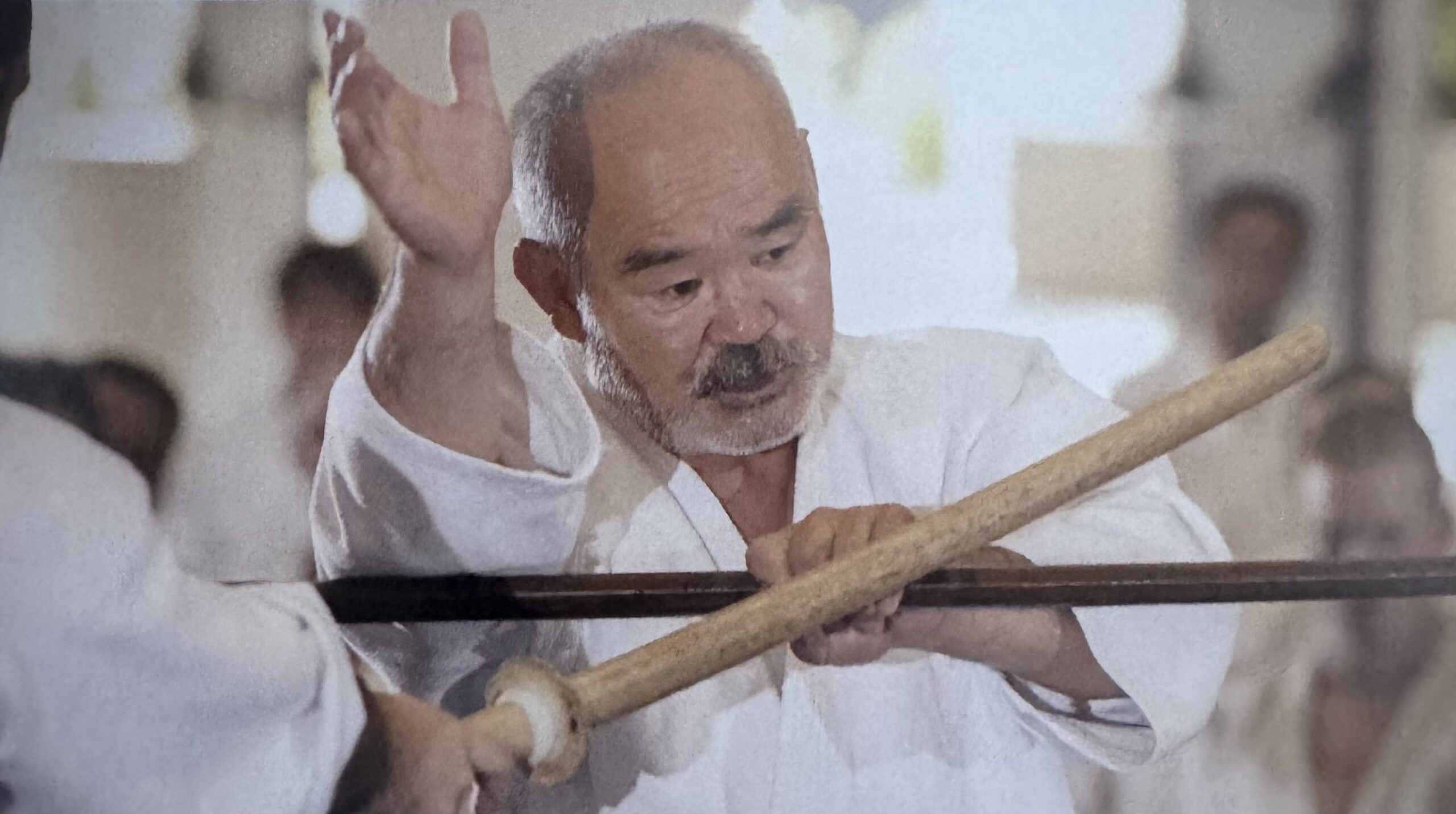
Editor’s note: this article originally appeared in Remembering Chiba Sensei, the chapbook given out at Summer Camp 2025.
Love this. Thank you, Dennis Sensei.
<3!
While I’m energized by the memories of Chiba, I reflect back to the ’70’s in London U.K where I practiced in his dojo. His magnificent presence was quite awakening for a young student like myself. His movement on the mat like that of the mystical dragon of ancient culture was indeed very inspiring. He would say “set aside your ego, and let your self nature project the technique and action”. To this day every irimi, tenkan and strike of a sword that I perform, that image comes to my mind and felt spirit. It was equally the same in the 90’s and 2001 and 2002, the last time I practiced in his classes. Thank you for the gift of a lifetime.
I had first practiced in his London U.K Dojo (’70 s) where I witnessed his inspiring presence. The same was true then as had been throughout the years to the end. While leaping around like the mystical ancient mythological dragon, his presence was fully felt by all his students. His one statement that always remains in my mind “Let your self nature to the work and set aside your ego”.
Thank you
Beautiful
Thank you for this encouragement to move forward and strive daily to be better at conveying both our love and knowledge of aikido.