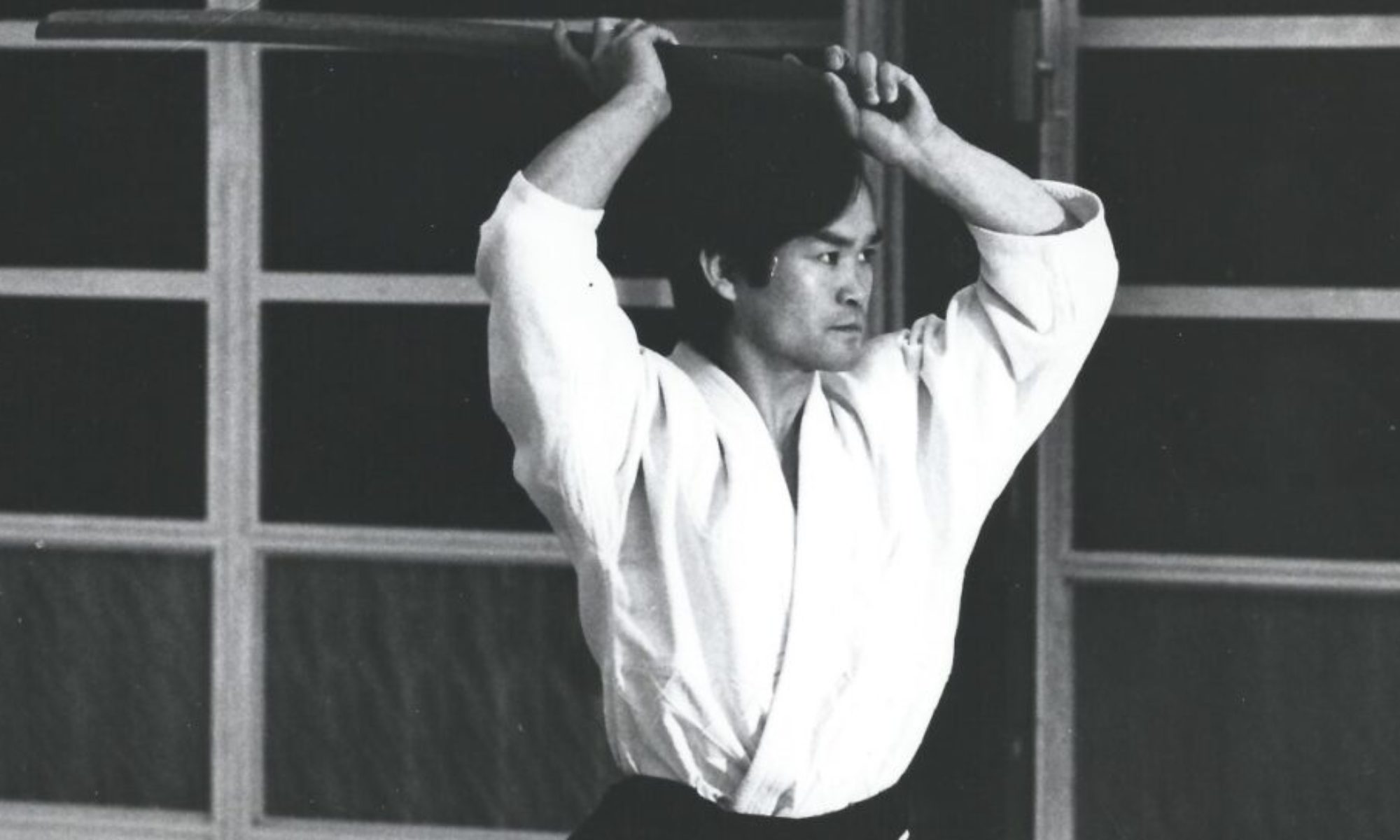
Robert Cohan
Editor’s note: Suzane Van Amburgh Sensei, my good friend, has requested (repeatedly) that the following article be reposted here, and at last I am doing so, as I have the utmost respect for her knowledge of movement. It originally appeared in Shuin, the Birankai Continental Europe Newsletter, January 2004. It is very long so I have divided it into two parts. Part I is a talk given by Robert Cohan and transcribed by Tamara Kohn, and Part II is the Q&A session that followed. It will post in two weeks.
Robert Cohan was born in New York in 1925 and began his professional career in dance when he joined the Martha Graham Dance Company in 1946. He was instrumental in the creation of the modern dance movement in England, becoming in 1967 the Artistic Director of the London Contemporary Dance Theater and School, which he directed for the next 20 years. He met Chiba Sensei in London in 1971. Their common interest in body arts led to sustained exchanges that soon developed into friendship. In 2002 Chiba Sensei asked Robert to share his long experience, the result of which is the following presentation.
About six months ago, Sensei Chiba asked if I would talk at this seminar about anything I chose. In thinking about what I could say to a group of professional and student aikidoka that would be worth your attention I came to the conclusion that dance, which I come from, and Aikido which you are doing, have something in common, something that I know something about and that is learning movement.
We all move all the time. We consider movement a sign of life. But there is movement and movement and movement. I am going to say there are three general kinds of movement that our body is involved in, and of these three I am going to concentrate on the third, which I will come to in a moment.
The first kind is autonomic or automatic movement. That is to say we have little or no control over it. It includes all of the automatic bodily functions that keep the body alive and functioning, from heartbeat to digestion, from sneezing to sweating. We start it with the first sound we make when we come out of the womb. That is the first body movement you make in space. Before then your heart has been beating, you’ve been kicking around, but you didn’t actually move the body in space. That is the first movement you make and from then on you move. We are seldom conscious of autonomic movement, although we can to a degree become conscious. For the most part we don’t want to interfere. For those of you who know how to control your heartbeat, you know that at a certain point it becomes dangerous – you don’t want to interfere with that.
A second kind of movement is the kind of movement or way of moving that we consciously or more likely unconsciously learned, as we grew from childhood to now. It is personal to us in every possible way and we do it all day long. It is the very way we move. It is like a signature, an identification of us. It is in fact the physical embodiment of who we are. You can identify people by the way they move – you do not even need to see their faces. It is a demonstration of our egos, of our personalities. This kind of movement we think of as natural but although the basics of what we do, such as walking, feeding ourselves, etc. are similar because we all have the same general structure, two arms, two legs, and a front and back with a head on top, the way we do the movement is not. Most of us do not naturally move well. For example very few of us can run well although you would think that running is a natural function.
This second way of moving is a learned response to a host of outside social factors imposed on us by the needs of the society we are brought up in. This includes all of our influences, from the scale of the space, the style of the furniture and the architecture of our houses to the way we physically related to our family as we were growing up and to the way we conformed to the social or local mores of our group, be they ethnic or racial or national. Think for a moment that in many places in the East people do not have chairs, in Africa people do not have chairs. Their way of moving is totally different as a natural function. They do not have cars, they do not have buses; Kenyans naturally run, very well and very fast.
From simple family orders such as, stand up straight, to the role models we chose to follow or look like or to certain attitudes having to do with gender, we altered the way we move. We are under a constant barrage in our early years to learn by trial and error how to adjust our physical movement and body attitudes to conform to our peers, so that we don’t seem out of place. In this second way we frequently learn to move from the wrong centers of our body. We frequently learn to move from our emotional or sexual centers instead of a movement center. We also learn to move badly. Since no one is really teaching us to move or really correcting us, all kinds of bad habits start to accumulate. Unless we are involved in a physical activity in our teenage years and into our twenties we can start to get weak and lose our ability to learn and coordinate new movement.
The third kind of movement that we do is also definitely learned but it comes from a totally different source. It is the kind of movement one needs to learn to do a craft or an art or a skill of some kind. It is designed to be functional like the kind of movement one needs to learn to suit a particular purpose, to do a particular kind of work.
It is the kind of movement that a surgeon must learn to operate successfully or a tight ropewalker must learn in order not to fall, or a dancer must learnt to be able to perform expressively, or a gymnast must learn or the kind of movement that you are learning here in aikido.
Someone other than ourselves almost always teaches this kind of movement and once we have decided to learn it, it may be exciting but it is always hard to learn at first.
The problem that we always have is that we think we already know how to move. After all we have been moving all our lives. We think the personal way we move isn’t a problem. All we need to do is learn the forms, the language. But this third kind of movement has two qualities that are new to us.
The first is that it is and must be done consciously. This is very difficult because to move consciously is so complicated that we can’t even consciously lift a hand to scratch our nose let alone to do a complicated form as you all have found out.
The second is that at first, and maybe for a long time it will not feel natural to us and to complicate matters we have to unlearn ways of moving that we may think are natural to us.
Now most of you have come to terms with this process to varying degrees depending on how long you have been practicing aikido and what physical condition you were in when you started. This learning process means we have to call on a part of ourselves we may not know too well and that is the part of ourselves that is capable of being objectively aware of our body; what it can do and is doing. It demands a kind of willing and open mental objectivity to physical learning, a centering, physically, in the body, and mentally, in our attitude, that will enhance our understanding and openness to learning.
Another problem we all face is that all this is going on inside ourselves and we are notoriously un-objective when dealing with our own attitudes towards our own feelings both physical and mental–emotional. For instance when a teacher shows a movement we have to be careful to see what is being shown. Not what we think is being shown. Instead of seeing we may be keeping up a running commentary in our minds while we are supposed to be watching. If it is something we think we know already we have to be even more careful as most likely we will see what we know and not what is being shown. If we have an injury it is likely to affect what we actually see let alone what we feel or do. If we are feeling nervous or tired again it will affect what we see. The same things will surely affect what we hear.
All teachers have the same experience of a student saying, “why didn’t you say that before” when it may be something that you have said or shown for months. It was just never heard.
Obviously what I am getting at is: who is doing the practice? Who are you when you come onto the mat? Who is present? Most learning involves the same basic process. The part of yourself that is capable of being taught must be the one who is here and in control. Not someone with any kind of attitude.
My own personal experience as a student and teacher for some 50 years has taught me that we simply cannot take our apparent willingness to learn or our presence in a class as sufficient motivation for the learning process to be effective. Over and over again we must work harder on who we are, at every moment on the mat.
In the ritual of the Dojo you have a very simple way of preparing yourself. You have the ritual of changing your clothing into something which is different from normal daily wear. As you change, be aware of leaving in the changing room with your clothes those parts of yourself that don’t belong on the mat. You have the Dojo itself, which is again, no matter how familiar, a special place. Then you have the removal of your shoes and the bow so that by the time you step on the mat you are the right person for what is to follow.
On television I saw a master class being given to a young ballerina by a great Russian dancer, Natalia Makarova. The dancer already knew the solo so Makarova said, “Okay, lets start. Come on stage from over there and begin.” The dancer went to the side of the stage, took a deep breath, walked to centre stage and took her position; the music started and she danced for 30 seconds.
Makarova shouted, “Stop! It’s just not right. When you do this you must look here, when you face here you must do this, etc. And you are just not right here. No. Lets start again.”
The ballerina went to the wings and entered again. She came to centre stage, took her position and was just about to begin when Makarova shouted, “Stop, stop! You are just not right when you take your position, to start you must be like this. You are not doing it. Start again.” The young ballerina went to the side of the stage, got ready and was just about to start to walk to centre stage. Makarova shouted “Stop! I can tell you’re not going to do it.”
This little event is a great lesson. What is it that Makarova saw, or didn’t see? Is this special quality or presence so visible? The answer is yes. We can often see it in other people. The problem is that it is hard to see or recognize it in ourselves. Certainly when we are embarrassed or caught by surprise and we feel dumb or badly “self conscious”, we know we are not going to move well or hear or see anything objectively. We all know that blocked sensation only too well but that’s not only what I am talking about.
It is when we think that we are smart or that we know something that we may be most unaware and wrongly centered. As a matter of fact if we have any attitude at all, it is likely to get in the way of our seeing, hearing, and learning. An attitude is a positioning of either the body or the mind and frequently both. I am going to repeat that: an attitude is a positioning of either the body or the mind and frequently both.
And this is very important, for this is what I’m talking about. Not an attitude in dance, but an attitude in the head. It’s not only intention. It’s a mental placement; it’s a mental filter. A filter so you see only one way, you hear only one way. You hear with your attitude. Sometimes it is a placing of ourselves in a defensive position; sometimes in an aggressive position but sometimes it is just an unconscious positioning of ourselves in a place where we feel comfortable, and this is dangerous.
In French do you have the same use of the word ‘attitude’ as in English? The difference is that in French the word attitude is a lot more passive, it’s a position. While in English an attitude has also – has the content of intent. In English, an attitude is mental, mostly. He has a good attitude, or a bad attitude. It is a mental positioning. And this is very important, for this is what I’m talking about. Not an attitude in dance, but an attitude in the head. It’s not only intention. It’s a mental placement; it’s a mental filter. A filter so you see only one way, you hear only one way. You hear with your attitude. Sometimes it is a placing of ourselves in a defensive position; sometimes in an aggressive position but sometimes it is just an unconscious positioning of ourselves in a place where we feel comfortable, and this is dangerous.
As a teacher of dance I have had several experiences that may be of use as examples. There is the situation where someone with talent comes to class all excited but so full of themselves and what they know that you can’t teach them; you can’t give them anything because there is no room. There is a general rule in life that If you want to drink the wine you should come with an empty cup.
Another situation that occurs is when a student who has had some good training cannot seem to expand himself or herself to take in what you have to offer. A defensive or protective attitude to what they already know interferes with any new learning.
I had a very talented dancer in my company who had a perfect physical and well trained body. His problem in learning was not only that he questioned constantly but that he judged everything he saw. Of course to learn well one needs impeccable taste in questioning but too often judgement, what’s right what’s wrong, what’s good, what’s bad, becomes a habitual positioning, an attitude that interferes with learning.
As one really learns how to move well the good practice becomes embodied in the muscles and articulation of the body. It becomes part of your experience, at present and living now, representing your good learning and practice in the past. Continual mental judgement becomes unnecessary, as the right moves are evident and transparent. You don’t need any attitudes.
Another area I want to comment on is teaching. This also has to do with attitude but I am not going to comment on teacher’s attitudes. In teaching serious dance there are some basic rules for teachers that I have been given and I pass on to other would be dance teachers. Perhaps they are of some use here as I think they are the same for teachers of Aikido.
Teach only what you really know.
Teach everything you know.
Don’t hold back anything. Sometimes you have such a good student you think, I’m not going to tell him that, it took me years to learn it.
You can only go up a step if you put someone on the step you are leaving.
The more you can give the more you will learn.
Teach with love. If you can’t love your students you can certainly love the art you are supposed to be teaching.
You will only get out of teaching what you can give to your students, but, at the same time that you teach everything, teach with care and discretion. Not everyone should know everything. Be careful who you teach.
To return to how to learn: the real question is always, “who is doing the learning.” It may be that the part of ourselves that is capable of learning and directing movement must be the one who is always present, because he has no attitudes but is simply you, yourself.
Experienced,
And Unprotected,
And Open,
And Empty,
And very Aware.
Thank you, Cecilia, for publishing this article in Biran, on the anniversary of Chiba Sensei’s passing. It is truly a gem. I’m grateful to Tammy Kohn for transcribing Cohan’s talk so many years ago – otherwise I would never have had the opportunity to read it. I’m also grateful to Coryl Crane Sensei for helping me re-find it in the original 2004 Shiun. From there I was able to render it in a format Cecilia could use for publication here in Biran. I love this article. I recommend readers keep your eyes peeled for the follow up “Q&A” portion as well. I’m happy to have this article reside in our Biran archive now, as it is truly worth re-reading on an annual basis. Domo arigato.
Apologies to Tamara Kohn for misspelling her name, it has been corrected.